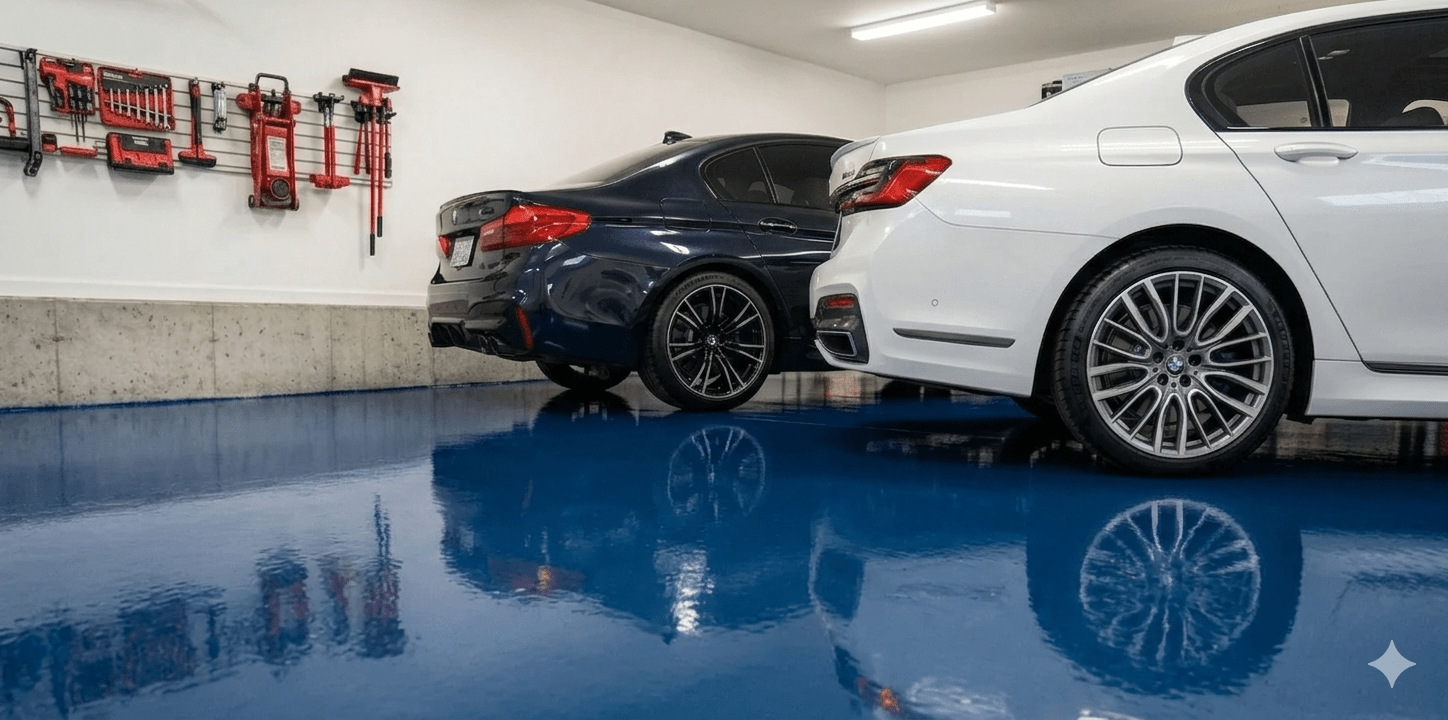
Solid Color Coating Clean. Seamless. Built to Last.
A solid color base coat in epoxy or polyurea, finished with one or two UV-stable tinted polyaspartic topcoats — giving you a bold, seamless floor that holds up to daily life without the chip pattern.
Diamond grinding to an ICRI CSP-2 profile. Cracks, pits, and surface damage repaired. This is the foundation everything else depends on.
02
Solid Color Base Coat
A high-build tinted epoxy or polyurea base coat applied directly to the prepared concrete for maximum mechanical adhesion and color depth.
03
Tinted Topcoat(s)
One or two coats of color-tinted polyaspartic or polyurethane topcoat. Adds UV stability, surface hardness, and a uniform finished appearance.
04
Traction (As Needed)
An anti-slip additive is mixed into the topcoat for residential jobs requiring grip. Sand broadcast is available for commercial and industrial applications.
Note : On traction: For most residential garages, we add an anti-slip additive directly into the topcoat — it delivers reliable grip without changing the clean, seamless look. Silica sand broadcast is reserved for commercial and industrial environments where heavy equipment like forklifts and pallet jacks require added surface strength and texture.
Choose Your System
Two Base Systems. Same Professional Result.
The base coat material is the key difference. Both are finished with tinted polyaspartic topcoats for lasting color and surface protection.
Epoxy System
High-Build Industrial Epoxy
Exceptional chemical and abrasion resistance at a competitive price point. The high-build formula bonds directly to prepared concrete, creating a solid foundation that performs under demanding daily use.
⚗️
Chemical Resistant
Resists oil, solvents, de-icers, and shop chemicals
🏗️
High-Build
Thick base coat, penetrates and bonds to concrete
🧹
Easy Maintenance
Seamless surface — sweep and mop, nothing more
💰
Cost Effective
Premium result at a competitive price
☀️
UV-Stable Top
Polyaspartic topcoat won't yellow or degrade
🦺
Anti-Slip Option
Additive available for residential traction
Best for: Residential garages, service bays, commercial floors where cost-effectiveness is a priority
Polyurea System
Fast-Curing. Flexible. Built for Minnesota.
Greater flexibility allows the coating to move with the concrete through freeze-thaw cycles without cracking or peeling. Faster cure times mean faster return to service.
🌡️
Temperature Flexible
Handles freeze-thaw cycles without cracking or lifting
⚡
Fast Cure
Faster return to service than traditional epoxy
💪
Superior Flexibility
Flexes with concrete movement, won't delaminate
🛡️
Impact Resistant
Absorbs impact better than rigid epoxy systems
☀️
UV-Stable Top
Lasting color and surface integrity indoors or out
🦺
Anti-Slip Option
Additive available for residential traction
Best for: Minnesota climates, heavy-use residential, heated/unheated garages, environments with temperature extremes
Slip Resistance
Traction Tailored to the Application
How we add grip depends on where the floor is going and what it needs to handle. Residential and commercial jobs are approached differently.
Residential
Anti-Slip Additive
🦺 Mixed Into the Topcoat
For homes and standard garage applications, we add an anti-slip aggregate directly into the polyaspartic or polyurethane topcoat. It delivers dependable grip underfoot without altering the clean, seamless appearance of the floor.
No visual texture — same smooth, polished look
Effective traction for foot traffic, wet conditions
Available in varying levels depending on preference
Does not affect color or sheen
Commercial & Industrial
Sand Broadcast
🪨 Broadcast into Base Coat
For commercial and industrial environments — warehouses, service bays, manufacturing floors — silica sand is broadcast into the coating system. Beyond traction, sand adds structural reinforcement to the coating layer, standing up to the stress of forklifts, pallet jacks, and heavy rolling loads.
Adds coating thickness and surface strength
Handles forklift traffic and pallet jacks
OSHA-level traction for high-traffic commercial areas
Required for true heavy industrial applications
Color Options
Choose Your Color.
Solid color systems are available in a wide range of standard colors. Check out available color options or request physical samples during your free consultation.
Canada Gray
Light Gray
Black
Sandy Beige
Rich Green
Regal Blue
Rotunda Red
White
Bright Yellow
Steel Gray
Charcoal
Tile Red
FAQ
Common Questions
What's the difference between the epoxy and polyurea systems?
Both systems use the same three-layer approach — base coat, sand broadcast, and polyaspartic topcoat. The difference is the base coat material. Epoxy offers excellent chemical and abrasion resistance at a cost-effective price. Polyurea adds flexibility and faster cure times, making it better suited for environments with temperature extremes or heavy impact. Chad will recommend the right system for your specific situation.
Does the solid color system use sand broadcast?
Not always — and for most residential applications, we don’t. For homes and standard garages, we use an anti-slip additive mixed directly into the topcoat. It provides effective traction without changing the look or feel of the floor. Sand broadcast is used on commercial and industrial projects where heavy equipment — forklifts, pallet jacks — requires the added structural strength and surface texture that sand provides.
What is ICRI CSP-2 and why does it matter?
ICRI stands for International Concrete Repair Institute. CSP (Concrete Surface Profile) is a standardized scale from 1–10 measuring the roughness of a prepared concrete surface. CSP-2 is the specific profile required for industrial coatings to achieve their full-rated adhesion. Without it, the coating sits on top of the concrete rather than bonding to it — which is why cheaper DIY kits peel and fail.
How is this different from a chip/flake system?
The solid color system uses a tinted base coat and tinted topcoats to produce a uniform single-color floor — no decorative flakes are broadcast. The result is a clean, seamless appearance without the speckled texture of a chip blend. If you prefer a more minimal, monochromatic look over the multi-tone character of a chip system, solid color is the right choice.
What sheen level should I choose?
Matte and satin are the most popular for garages and commercial spaces — they look professional without showing every scuff or footprint. Gloss is preferred for showroom-quality finishes where maximum visual impact matters. Chad will bring physical samples to your consultation so you can compare in person before deciding.
Can I get a custom color?
Yes. The swatches shown are standard options. Custom color matching is available — bring a paint chip, hex code, or any color reference and we can work with our manufacturer to find the closest match. Physical samples are brought to your home during the free consultation.
CTA Banner – Distinctive Garage Floors
Ready for a Clean,
Durable Floor?
Schedule a free, no-obligation onSchedule a free, no-obligation on-site consultation. Chad will assess your concrete, walk you through system and color options, bring physical samples, and provide a custom quote — at no cost to you.